PUBLISHED IN WSJ
Chambers of Secrets
Want to impress your most cultured travel companions? Curators of some of the world’s best museums share their institutions’ most insider-y discoveries.
THE METROPOLITAN MUSEUM OF ART
I’VE VISITED THE METROPOLITAN MUSEUM OF ART in New York enough times that it feels almost as familiar as the home I grew up in. So imagine my surprise when a friend, lost at the Met, texted me: “Did you know there’s a Frank Lloyd Wright room?” I did not.
Even after countless visits, museums can reveal new secrets. Hoping to unearth more, I talked to curators at some of the world’s most storied institutions about their favorite hidden-away corners and pieces of lore.
Fragrant Fingers
While visiting the Prado Museum in Madrid, I was confused to see the Mona Lisa, a piece I knew belonged to the Louvre, a museum a country away. This second Mona Lisa, I learned, was painted around the same time as the more famous one, by Leonardo da Vinci’s assistant (and rumored lover).
Alejandro Vergara, chief curator of Flemish and Northern European painting at the Prado, points out another intriguing bit of subtext: the “amber gloves” seen in portraits stretching from the 15th to the 17th century. So-named because they were perfumed with ambergris, a substance produced by sperm whales, they masked body odor with a pleasant scent. “The world smelled bad—they weren’t into cleaning as much as we are,” Vergara said. “An expensive, fancy court gift was perfumed gloves.”
The Prado even worked with a perfumer to re-create the original scent. You can press a lever in Gallery 56 to release the aroma of the gloves seen in the portraits of Queen Mary I and the Holy Roman Emperor Maximilian II.
When Bulls Fly
Ariane Thomas, head of Near Eastern antiquities at Paris’s Louvre, likes the story of the flying bulls, a set of 28-ton Assyrian sculptures from around 713 B.C. depicting human-headed, winged bovines. “In the 1990s, they had to close the entire Rue du Rivoli and open a wall to make it possible for them to enter the museum,” Thomas said. “We made them fly,” she said with a laugh, explaining how cranes had to carry them into the glass-covered Khorsabad Court.
Another of Thomas’s favorite insider tidbits hides within the Iberian Collection. Most onlookers don’t realize that a set of extraordinary ancient stone heads carved more than 2,000 years ago—with exaggerated features and almond-shaped eyes—are the very pieces that directly inspired Pablo Picasso’s Cubist period.
A Room Apart
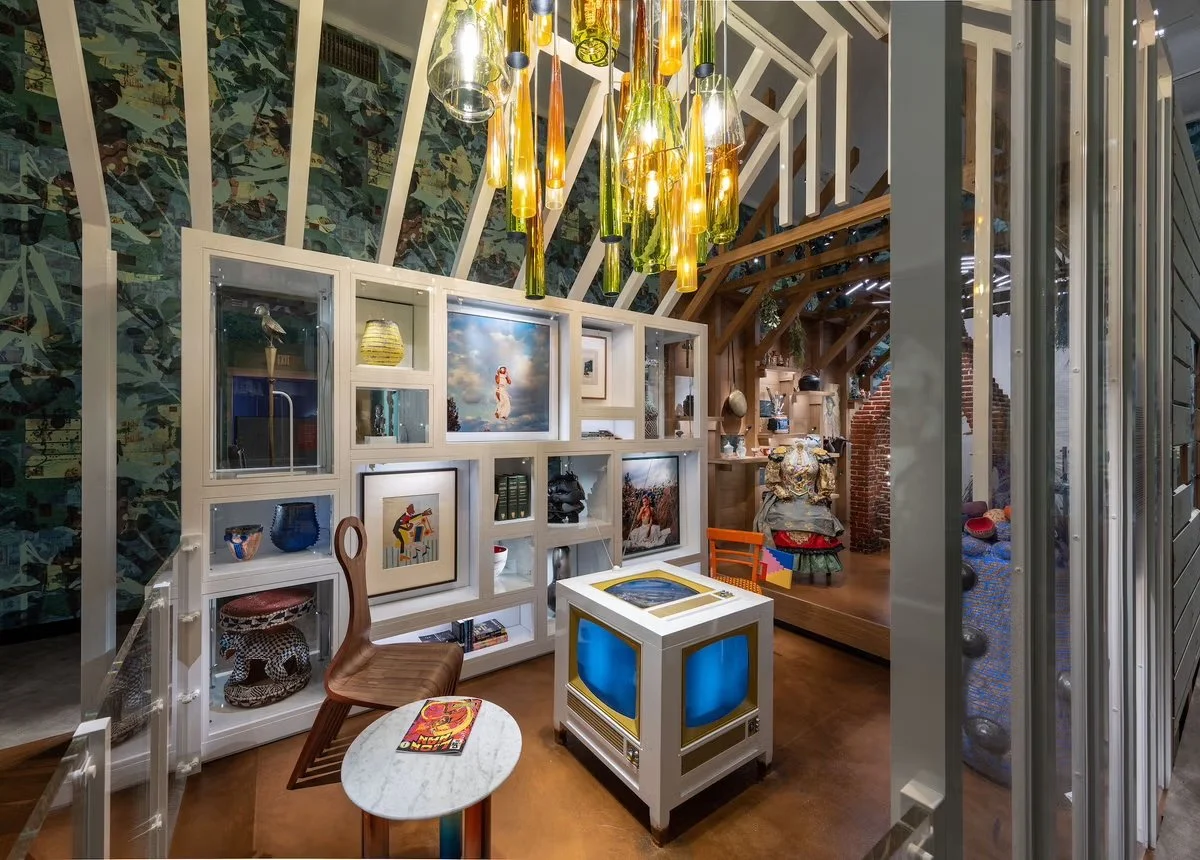
The Met’s “period rooms” are curated to accurately reflect different historical eras. However, one of those rooms strays from the past, says Lisa Sutcliffe, the Met’s curator of photography. Steps from the colonial furniture of the American wing, an Afrofuturist room, opened in 2021, depicts a hypothetical world in which Seneca Village, the vibrant Black community displaced in 1857 to create Central Park, was allowed to thrive.
“The Met is so known for these period rooms that represent the domestic interiors of an affluent Western culture,” said Sutcliffe. “But this is a very different kind of room that imagines a potential future”—specifically the home of a 21st-century Seneca Village resident, featuring imagined technology like a 5-screen television, and decorations emblazoned with Black icons like Harriet Tubman and Erykah Badu.
A Watery Death Wish
Most visitors to Mexico City make a beeline for the National Museum of Anthropology, but some locals consider the Anahuacalli Museum the city’s most intriguing destination. Samantha Ozer, the artistic director of the TONO arts festival, finds the Anahuacalli’s history as fascinating as its collections of pre-Hispanic artifacts. The muralist Diego Rivera dreamed up the museum in 1942, modeling it after an Aztec temple. “The whole idea was that it would house his collections, but also spaces for dance, for music, for different things,” Ozer said. It finally opened seven years after Rivera’s death in 1964. He wanted to be buried in the museum’s subterranean level surrounded by water, a wish unfortunately unfulfilled. “He wasn’t spiritual in the religious sense,” Ozer said. “It was very aesthetic for him. He called it a temple for art.”
Papal Passions
If you take in the vast “Farnese Collection” at Naples’s Capodimonte Museum—replete with works by Titian, Bruegel and El Greco—you might not know it all started with a scandalous affair. To understand its provenance, says curator Patrizia Piscitello, focus on Raphael’s 16th-century portrait of Cardinal Alessandro Farnese. At the time it was painted, she explains, Farnese’s sister, known as Giulia the Beautiful, was sleeping with the corrupt and philandering Pope Alexander VI. It’s thought that Giulia’s affair was instrumental in eventually granting her brother the papacy when he became Pope Paul III—and the wealth to procure such an impressive art collection.
POST-MUSEUM MEALS
Curators on their go-to restaurants
You can work up an appetite touring museums. Here, curators dish on their favorite after-work bites.
Alejandro Vergara, a curator at Madrid’s Prado Museum, recommends Murillo Cafe, a modern bistro featuring Venezuelan touches. He’d head there, he said, “even if it wasn’t next to work.” For something more casual, he recommends La Dolores, an old-school tavern five minutes from the museum: “It’s a classic tapas bar, very famous and very good.”
Ariane Thomas of the Louvre is partial to Le Fumoir for its fresh, Scandinavian-inflected fare and 1940s-style interiors. For a traditional bistro, she recommends Le Voltaire, right across the bridge from the museum.
Lisa Sutcliffe’s spot near the Met for a special occasion is Bemelmans Bar at the Carlyle Hotel, a place that measures up to the museum’s grandiosity. “It’s a nice place to have a Martini, listen to some music and talk to a friend.”
If you’re visiting Mexico City’s Anahuacalli Museum, art director Samantha Ozer recommends planning ahead and grabbing a bite in the neighborhood of Coyoacán first, as the museum is somewhat remote. Try Los Danzantes for Oaxacan dishes like slow-cooked moles. An option closer to the museum is Marisquería El Pulpito Pirata: “Think plastic chairs and a smaller menu full of shrimp, fish, and octopus.”
In Naples, Patrizia Piscitello, of the Capodimonte Museum, likes Giardino Torre, a pizzeria that boasts a historic oven and is set in a garden. The restaurant claims the pizza Margherita was invented here in 1889. The verdant surroundings only add to the experience.