A STORY BY NINA RENATA ARON
PUBLISHED IN PRIOR
The Enduring Potency of Like Water for Chocolate
What the Mexican novel and its vibrant reimaginings teaches us about love, hunger, and gastrodiplomacy.
When the beloved Mexican novel Like Water For Chocolate was reimagined yet again, this time in a Max miniseries by Selma Hayek, I had memoirist Nina Renata Aron return to the tale. Within, she examined what the enduring story and its vibrant reimagining teach us about love, hunger, and gastrodiplomacy.
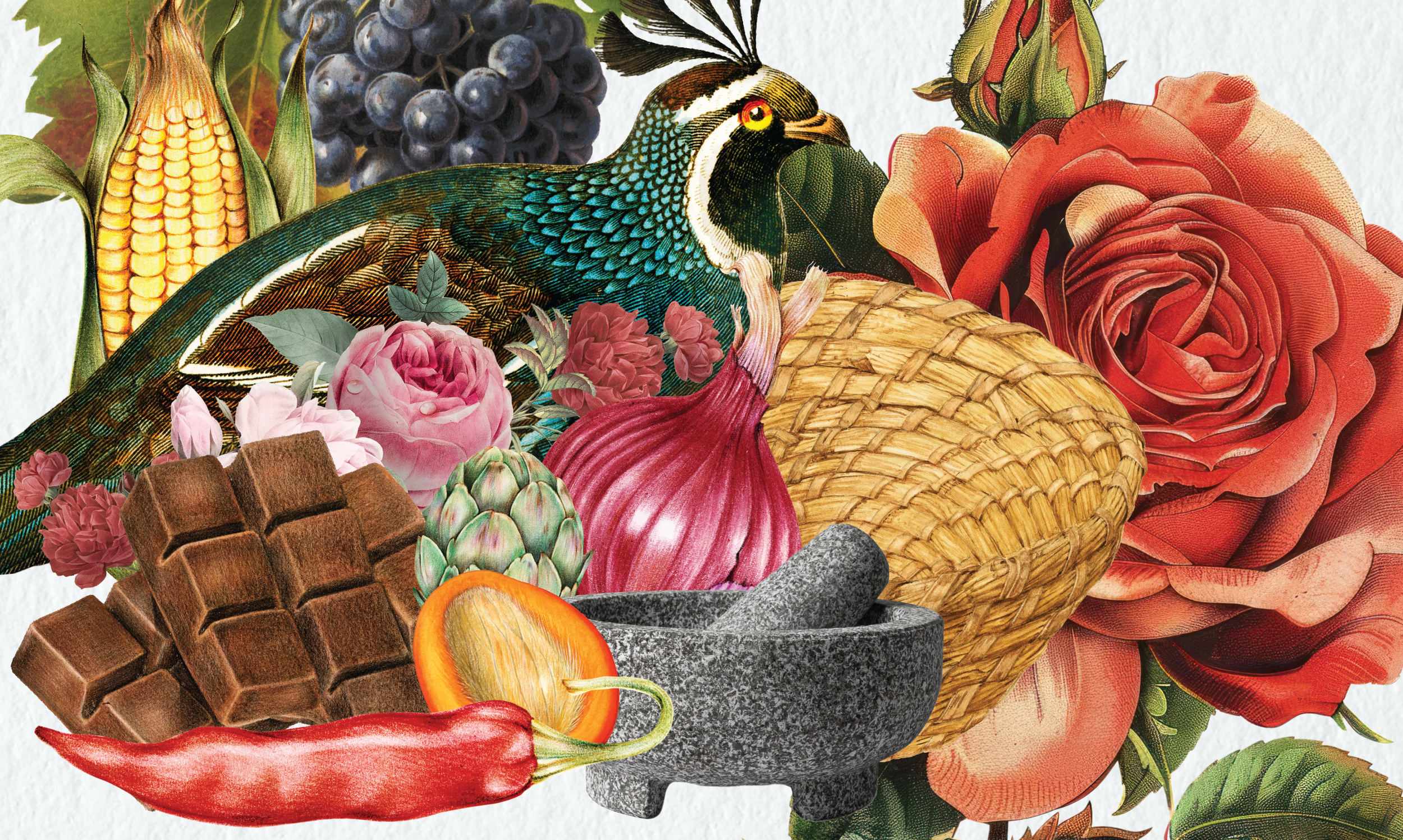
ART BY CHRISTIAN MARTIN
JUST AS CERTAIN MEALS IMPRINT THEMSELVES ON ONE’S MEMORY, certain stories are indelible. For me, Laura Esquivel’s Like Water for Chocolate is one of these. In fact, much of what I know about love and hunger came from the bewitching Mexican novel. How to charm a man with food, put my own spin on an inherited recipe, cook my way through heartbreak. This might sound like hyperbole, but it is completely in line with the heightened passions of the world Esquivel conjures. A novel in 1989 and a film in 1992, the tale has most recently been vibrantly reprised in a new Max series produced by Salma Hayek Pinault, with food scenes so vivid you can almost taste them. I am, as the kids say, here for it.
Like Water for Chocolate — the novel — was first sent my way by a literary aunt known to pilfer appealing galleys from her publishing job and pop them in the mail. Its turquoise cover bore the painted image of a placid young woman with a scarlet flower behind her ear, making tortillas in a kitchen. I guessed that was supposed to be the protagonist, 15-year-old Tita de la Garza — the book is narrated by her great-niece — but as I read about this brave young woman torn between love and tradition, I pictured someone with far more pluck.
Perhaps I was seeking someone to look up to. Like Water for Chocolate came into my life at a time when the dual interests of my nerdy youth — reading and eating — were competing for the first time with something else: desire. There was lust, yes. I was a teenager, after all, like Tita. But more than that, much more, there was the desire for love. The desire for the power to make the person I loved love me back.
I had recently learned my grandparents’ love story — the immediate electric charge they felt for each other when they met at a radio station in New York City where my grandfather was playing live music. The pair fell in love so quickly that they were married within two weeks. To hear my grandmother tell it, decades of passion followed, as did four children. At the time, I was also starting to learn some of my grandmother’s recipes, Jewish and Eastern European classics she often prepared by memory, taking liberties and making substitutions with an authority I admired. I was learning that improvising in the kitchen was like an art form. In Like Water for Chocolate, Tita is described as “the last link in a chain of cooks who had been passing culinary secrets from generation to generation since ancient times.” I was moved by this basic premise: a little girl who is a good eater becomes a good cook, carries on family recipes and — though stuck within the confines of home — satisfies her hunger for life, for adventure and rapture, with transcendent food
In the story, Tita lives on a ranch in northern Mexico at the beginning of the twentieth century, during the Mexican Revolution. The threat of violence at the hands of federales looms. She longs to marry a neighbor, Pedro, whom she believes loves her too (she’s right), but her stern mother insists that as the youngest, Tita must care for her until her death. So her sister Rosaura is married off to Pedro instead, a betrayal that kicks off a star-crossed love affair on par with Romeo and Juliet.
One key difference, though, between this and Shakespeare, is the food. Oh, the food. The story covers one particularly dramatic year in the life of its heroine, and each month begins with a recipe. Christmas Rolls in January, Chabela Wedding Cake in February, and so on. There is Quail in Rose Petal Sauce, Oxtail Soup, lasagna-like Champandongo, in which tortillas are layered with meat, cheese, and sauce, and memorably appetizing Cream Fritters, fried squares of eggs and cream served in hot syrup and sprinkled with cinnamon, like french toast without the dense middleman of bread.
When it comes to food, Tita was born into it — literally. She arrived prematurely, Esquivel writes, “right there on the kitchen table amid the smells of simmering noodle soup, thyme, bay leaves, and cilantro, steamed milk, garlic, and, of course, onion.” From the beginning, the kitchen is her domain. And as her forbidden love for Pedro blossoms, she has no choice but to communicate it through the meals she makes. The book takes a magical realist turn. Tita weeps into the batter for her sister and Pedro’s wedding cake, and her anguish is baked into the confection. The moment the guests take their first bite of the cake, “everyone was flooded with a great wave of longing.” There is collective sobbing, then collective vomiting. Later, Tita feeds her infant nephew from her own breast until he “sleeps like a saint,” even though she’s still a virgin and obviously isn’t lactating. The message? Love makes edible miracles happen.
The inverse is true too: food that is divine makes love happen. Tita’s desire for Pedro grows so unwieldy it is dissolved into the rose petal sauce she prepares. “That was the way she entered Pedro’s body,” Esquivel writes. The tortured young couple discovers a new “system of communication.” Tita's cooking is an ode to Pedro, to love itself. He stares into her eyes while eating, and says, “Thank you. I have never had anything so exquisite.” It’s a literal take on the idiom that the fastest way to a man’s heart is through his stomach. (You’ll have to read the book or watch the series to find out whether Tita and Pedro ever do actually end up together.)
At a broader cultural level, it might also be argued that the fastest way to humanize a people is through their food. At the time of the story’s publication (as now), there was stark bias in American representations of everyday life in Mexico — primarily the result of racism, which informed the War on Drugs and the perception of economic instability. Through its rich portrayal of the kitchen as a microcosm of Mexico, the novel performed an early form of gastrodiplomacy, teaching about flavor while also revealing complex details of Mexican history and culture, such as the nuances of class and racial stratification in a place so often seen as a monolith by the U.S. All this was well before Mexican gastronomy achieved its deserved status as one of the world's great cuisines, before your friends were coveting reservations at Pujol and hashtagging carnitas in CDMX. Perhaps the book struck a chord for me in part because it was, in a sense, radical — or, in making Mexico visible to a young girl in New Jersey, at least ahead of its time.
Looking back now, I can also see that the torment Tita experienced was perfectly tuned to the strong emotional storms of adolescence that I was going through at the time. When she faces grief, for example, she imagines all the dishes in the house exploding at once. I may have been dealing with a crush, not watching my sister marry the love of my life. And my interest in cooking was forged in the suburbs, not in a time of deprivation or unrest. Still, like Tita, I was learning about the ways food can accentuate, amplify, or ease an intense mood. It can play peacemaker, communicate a message, or simply serve as a balm for hard times.
I think another reason Like Water for Chocolate endured in my memory all these years is that the experience of food in the story is so bodily — bound up with sustenance and the rhythms of everyday life, but also with the ineffable forces that give our lives meaning. I had never before encountered a character like Tita, who so naturally lived with, for, and through food. And this was real cooking, rustic cooking, long before “local” and “seasonal” were fussy culinary buzzwords.
In the cold months, Tita puts warm eggs in her blouse to relieve her chill. In the summer, when the heat is unbearable, the family puts a large earthenware jug full of ice out on a table and places a cut up watermelon inside “in case someone was hot and got up in the middle of the night wanting to eat a slice to cool down.” I first read the book in the blank heat of summer and couldn't think of anything that sounded better than a glacial slice of middle-of-the-night melon. The most memorable moment for me is unremarkable in the story: it’s a scene where Tita appears in a new dress, carrying a tray of “egg yolk candies.” I now know these were likely a riff on Yemas de Santa Teresa, a custardy, sugar-dusted Spanish dessert, but when I first read this, I couldn’t just look it up. Pre-internet, all I could do was imagine what egg yolk candies could possibly look like. Big, lemon-yellow lollipops? Glazed, gelatinous entremets?
Generally speaking, there were far fewer pictures of food readily available then, to say nothing of viral cooking videos. Instructions for how to make food mostly lived on paper, whether in published cookbooks or on handwritten family recipe cards. An as yet un-Google-able concoction could obsess the mind the way a painting might obsess the painter before she has produced it. I was just starting to learn to cook in those days and in my mind’s eye, the sunny yellow of those egg yolks had the same shine as the cherries I situated atop a kugel at my grandmother’s direction — fat, glazed cherries the color of fresh blood in a jelly-like sauce.
It makes sense that those egg yolk candies made a lasting impact. They’re like the apple in Snow White. Similarly, Like Water for Chocolate is a kind of culinary fairy tale. But not a sanitized cartoon. The old kind, filled with beauty, humming with danger. In fairy tales, characters are destined for particular things. Tita is fated to rule over the culinary realm, and that very idea, that a person could be fated for a life dedicated to food, was a powerful one for me. It meant a life in the kitchen, yes, with all its heat and steam and attendant drudgery, but also a life of rich flavor, color, and the special power that comes from feeding others well.
I haven’t devoted my life to the kitchen, as Tita did, but I do cook every day. And, just as for Tita, the great loves in my life are deeply associated with certain dishes, the ones I made to impress or please or keep these loves, or simply the ones we enjoyed together, believing briefly that it would all last forever. I can think of them now: pasta puttanesca, jalapeño-infused tequila, Italian dolci di noci, and the wildflower honey my current and final partner once boldly kissed off my lips. Food may be the quotidian stuff of life, Esquivel’s story taught me, but it is also what gives life its texture. In the case of our most cherished recipes, it may be what endures long after we’re gone.
Longing for more Northern Mexican food? Three chefs from the region share their most essential dishes.
1. “I think an essential northern Mexican dish is the burrito, which originated in the borderlands. Its cradle is the city of Ciudad Juarez. It’s emblematic because it’s made with fresh flour tortillas, a delicious fat (depending on the region, that can be beef tallow, lard, butter, or even vegetable shortening), and it has a filling so good it can stand on its own as a main dish. They’re made with tortillas so good they taste like flattened biscuits (!) and that homemade filling — you’re taking a meal on the go, but with the taste from a Mexican home.”
—Pati Jinich, host of PBS television series “Pati’s Mexican Table” and PBS primetime docuseries “La Frontera.”
2. “My parents are from Ejido Hermosillo in Baja CA. My mind immediately goes to my summers spent in Ejido Hermosillo, where I’d wake up to warm homemade flour tortillas. My mom would roll up a fresh flour tortilla with a little butter for me to enjoy while breakfast was served. The best! I didn't realize how classic a flour tortilla was in northern Mexico until I met my husband, who’s from CDMX, and who’d never had a homemade one with butter — I was shocked! As my family crossed the border into Mexicali, stopping for street tacos was always a must. An essential dish is tacos de carne asada al carbon on a fresh-made flour tortilla with a salsa roja tatemada.”
—Janeen Mendoza Cruz, owner of salsa company Kuali
3. “One of my go-to tacos in Tijuana, in the north of Mexico where I'm from, is a double-tortilla birria taco that they dip in birria fat and then throw in the flat top. It makes the outside tortilla crunchy, but the inside tortilla is super soft and juicy. They put the birria inside, then crispy tripas (tripe) at the last minute, then your standard cilantro-onion concoction. It's amazing because you have crunch from that outside tortilla, which is a little bit burnt, and crunch from the tripe, and then the juiciness of the meat. That's one of my favorite tacos.”
—Jose Luis Hinostroza, chef and owner of Arca
4. “Menudo is an essential northern Mexican dish, celebrated for its rich and flavorful broth as well as its deep cultural significance. In northern Mexico, this hearty soup is a Sunday morning staple, deeply tied to tradition. For me, menudo is a comforting reminder of my childhood.”
—Fidel Caballero, chef and owner of Corima