PUBLISHED IN DOSSIER
In Conversation with Steven Soderbergh
The film director on his second act in spirits and the power of “showing up for shit.”
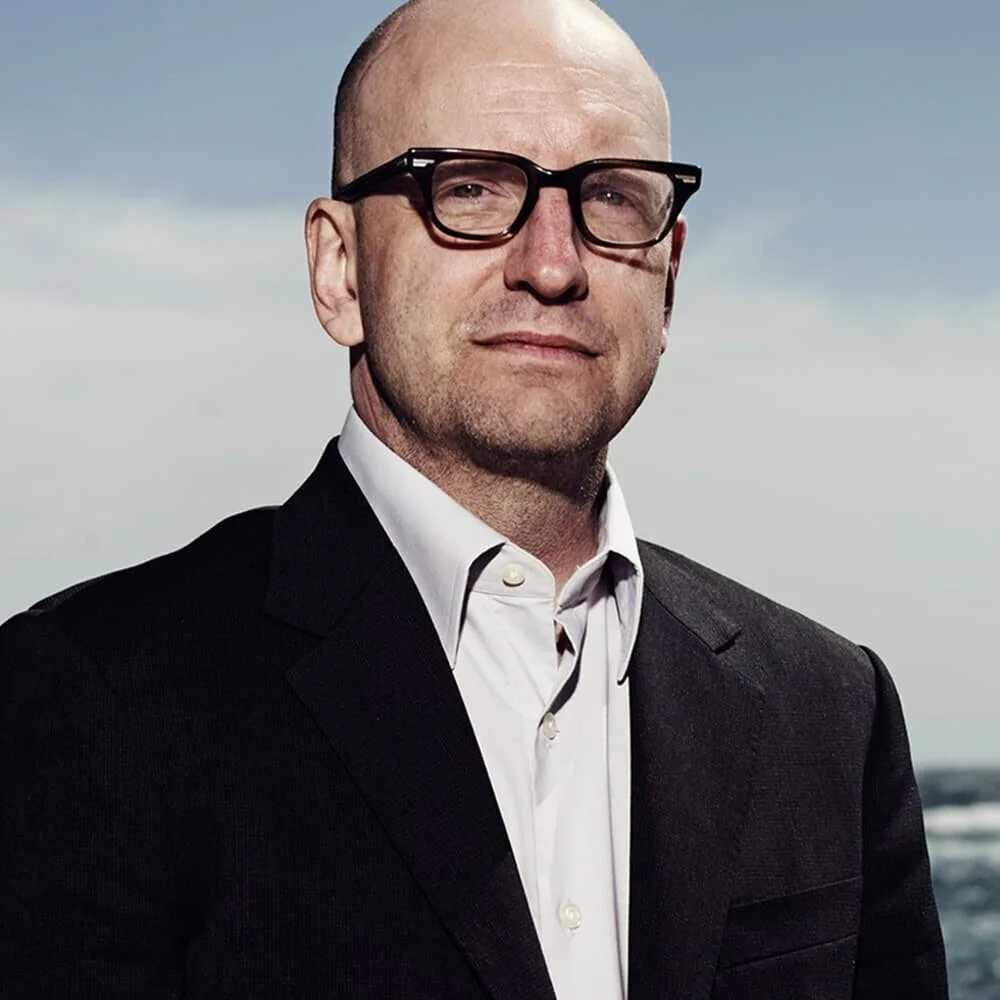
ONE OF THE GREAT ENTERTAINMENT MULTIHYPHENATES of our time, the Academy Award-winning director, writer, and producer Steven Soderbergh has earned his accolades shaping some of the most influential films of the 21st century: biographical drama Erin Brockovich, heist film Ocean’s Eleven, comedy-drama Magic Mike, prescient thriller Contagion, two-part biographical film Che (more on that to follow), black comedy The Informant, genre-bending horror film Presence … The list goes on.
Far fewer know about his second passion: singani, an elusive 500-year-old Bolivian spirit. Singani comes from muscat of Alexandria grapes, which originated in Egypt before traveling to Spain and, thanks to Spanish missionaries, landing on a tiny plot of land in the Bolivian Andes. Soderbergh was introduced to the national spirit in 2007 while working on Che in Bolivia’s jungles. One sip and he was hooked. An 18-year journey followed, which culminated in the launch of Singani 63, a brand developed in collaboration with Casa Real (the Bolivian distillery behind that first mesmerizing sip), which has boosted the spirit category’s recognition both within the US and internationally.
Far from the maddening crowds of his movie existence, I had a conversation with Soderbergh about his second, spirited life.
Sophie Mancini: What sensations arise when you taste singani?
Steven Soderbergh: It's a real indication of how different everybody's taste buds are: people saying it's like a gin; others saying it's like a tequila. When I first tried it, I was picking up very floral flavors: like an elderflower thing, a peppery thing. Then I swallowed, and it just vanished. I was used to drinking 80-proof spirits and having to endure what I called “the second swallow,” which was just the price you had to pay to get into the end zone. This stuff just disappeared — there just wasn't anything like this.
SM: What was it like trying to bring the spirit to a global audience?
SS: I've been making notes for a show about somebody trying to bring a spirit to market. It's very cinematic. There's a lot of travel; there's a lot of night stuff. You're in hotels and bars and restaurants. You're dealing with the government, the states. The personalities are fascinating. The analogy that I use is: You're campaigning for an election that's never going to take place. It never stops. There is no “you won, you lost.” In my day job, you have peaks and valleys. You initiate a project, you develop it, you shoot it, you finish it. Then there's a lull, and then you start on the next project. This is not like that. This is like shooting every day. If you slow down, you just get run over by all the other brands trying to get their spot on the back bar. It's absolutely ruined bars and restaurants for me. Now I’m doing a deep dive on their cocktail program instead of having fun. Once you're in it, it's like a tattoo.
SM: Have you always been drawn to impossibilities?
SS: My whole career is a massive mathematical improbability. I grew up in a suburban subdivision in Baton Rouge, Louisiana. I knew nobody in the entertainment industry — had no contacts whatsoever, but I absolutely felt: Well, somebody's got to breakthrough. Why shouldn't it be me? So I started making short films, but I was also writing all the time — even though I didn't like writing, because nobody could stop you from writing and it cost nothing. I finally wrote something that was small enough and appealing enough to actors to get a little bit of money to make a movie. That was when Sex, Lies, and Videotape happened. For a lot of people, it seemed like I came out of nowhere, but the film was an eight-year overnight success. So I'm used to the slog, you know? You increase your chances of having life-altering experiences if you show up for shit … and I mean that in the literal sense.
SM: Were there any other aspects of Bolivian culture, tangible or intangible, that resonated with you?
SS: I was with the [Bolivian] vice president at a dinner once and said, “I'm of Swedish descent, and the Swedes are known for having a certain kind of reserve. They play things close to the vest. I feel that the Bolivians are the same way, in a way that's very familiar to me.” I asked him, “Am I out of my mind?” He goes, “No, absolutely not. Bolivians do not self-promote in the way that some other cultures do — could be because we're landlocked. We're the only landlocked country in South America.” Bolivians have an incredibly wide variety of plants. So they have a very interesting food and beverage culture. They just don't get a lot of play on the world stage, which is why, when we got the category here, it was on the front page of the newspaper the next day. [Singani] is something they do that is world-class, that now people are starting to know about.
SM: What's the cultural lore around singani — is it connected to any Bolivian social rituals?
SS: Luis Pablo Grenier, the fourth-generation family member to run the [Casa Real distillery] says, “When I was a kid, if I had a cold or I was sick, my grandmother would rub some [singani] on my upper chest and my throat, like it was the Vicks VapoRub substitute.” So it’s very, very embedded. It's 500 years old. There has been singani for longer than there's been Bolivia. So people there really do have a primal connection to this spirit.
SM: Let’s talk about the rarity of this thing.
SS: You're talking about a single varietal of grape at or above 5,200 feet above sea level, in one 20,000-acre area of southern Bolivia. Talk about bespoke. That's tighter than champagne, tighter than cognac. I hope it becomes an interesting aspect of our world domination, which is: There is a limit to how much you can make. It is a bespoke spirit. It's not going to be Casamigos. George [Clooney] knows how I feel about that ...
SM: What flavors go well with singani?
SS: It's got a huge food relationship to draw upon because it's so versatile. I don't think you can find another spirit at this proof level that can make this many cocktails, that you can swap out for a brown spirit and have it work. Somebody described singani to me as egoless. When you put it in a cocktail, it just kind of finds its place. If it needs to sit back and play tambourine, then that's what it does.
SM: It’s fun to think about the personification of the spirit. This little fighter who punches above its weight, standing on its own as well as chameleoning into different flavors.
SS: The weird thing is the spirit mirrors my perception in the entertainment industry. I'm known as somebody who goes their own way, does their own thing, but also plays a lot of different positions — producing, directing, writing, shooting, editing. I'm perceived as sort of a Swiss Army Knife. This is that.
SM: What was it like drinking singani for six months straight while you were filming in Bolivia?
SS: I look back on it as one of the reasons we were able to survive that shoot. Those were not fun movies to make. Some people just turned into zombies or roadkill. It got too intense. Without the ability for the core group to decompress after a day of shooting by sitting around and having a singani on the rocks, it would have been a very different shoot. I also discovered I was not in any way affected the next morning. It's so well-distilled, there are so few impurities in it, that you were not punished the next day. It's not a drunk, it's a buzz. It's more like a high than a drunk.
SM: It sounds kind of mystical.
SS: I was trying to convince somebody at one of the medical universities, here over at Columbia [University], to do a series of experiments where we got people drunk on different spirits and then [doctors] did MRIs of their brains to figure out if there was a difference in the way singani was affecting their brain, rather than, say, tequila. I talked to this guy a couple of times. He was like, “I don't know if I'm allowed to do that,” but I’m convinced it does something to your brain that's different from gin.
SM: I find it so evocative — this idea of an ancient spirit holding secrets.
SS: You think about the ground that this grape grows in and what's happened to it. Supposedly, one of the reasons it's a terrible place to grow something is that 10,000 years ago it was all under water, and when the water left it took all the minerals with it. These grapes have really been hanging on.