PUBLISHED IN DEPARTURES
How To Eat Plants
Peeling back the layers with Eleven Madison Park’s famed chef Daniel Humm.
PHOTOGRAPHS BY SEAN SULLIVAN
IN JUNE OF 2021, CHEF DANIEL HUMM announced that Eleven Madison Park’s menu would become entirely plant-based, the only move of its kind for a Michelin three-star restaurant. Since the news broke, it has been splashed across every media outlet from every angle — an endless source of international fascination and dinner party debate. Approaching December’s heavy indulgence, I wanted to ask Humm about this shift toward more conscious consumption, along with the outsized controversy it’s brought.
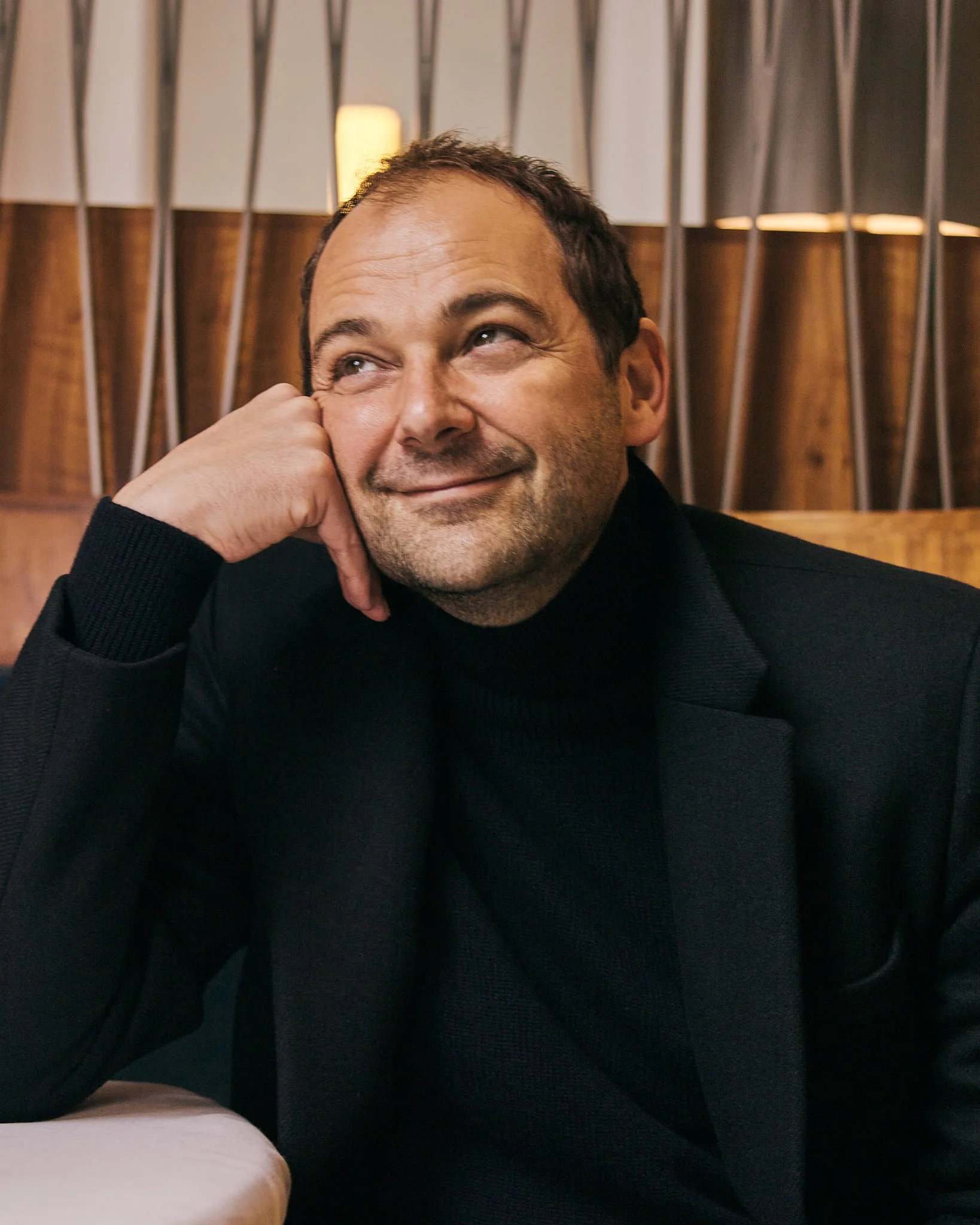
For those who’ve never seen him in person, Chef Humm is extremely tall, yet exceptionally good at making himself seem smaller. Folding his hands on the table between us, he sank his broad shoulders and head down low. His manner of speech has often been described as slow and deliberate. It is. But his manner of listening was more notable. He maintains unerring eye contact, hanging on every word with reverence, as if visualizing them in the air.
Can you describe the moment the idea of turning Eleven Madison Park entirely plant-based came to you?
I've been playing with this idea for a long time. I always knew that the most creative work was with vegetables. But really turning the restaurant into a community kitchen during the pandemic had a big impact. We cooked over a million meals for food-insecure New Yorkers and it brought up a lot of things like: What is luxury? What does it even mean? It’s just this idea. I mean, there’s no way around it — Eleven Madison Park is a luxury brand. So then what is our role within that?
I reached the mountaintop of what a fine-dining restaurant can reach. And it didn’t feel all that meaningful. Then the pandemic, and the work with Rethink [the food nonprofit Humm works with] producing these meals, being in these underserved communities ... I thought maybe this was just my next chapter. Maybe fine dining isn’t important anymore. Does it make sense to obsess over food the way we do in a city where some people have no food?
But then I also thought about all the great people in food — chefs and figures I admire, who I want to be. I like Alice Waters’ story a lot, how Chez Panisse is a restaurant, yet what she does is so much bigger than the restaurant. Food
is involved with so many issues we’re facing: food insecurity, food in schools, food as education, farming, obviously global warming. And with global warming, no matter where you look, animal farming is either the first or the second biggest contributor. The actual moment I made this decision was when I went for a run one day in Central Park. But what I didn’t realize was how big of an impact it would make. I’m invited to speak at the UN, at COP26. People are paying attention. It’s humbling.
If everyone has this knowledge that going plant-based is one of the most impactful ways to reduce our carbon footprint, why do you think EMP is the only restaurant of its kind to make this change?
Because this change is so big. There is a whole culture of fine dining, of French cuisine, of chefs ... I had to convince my most trusted people that this was the way forward. Our business is responsible for a lot of livelihoods. And with this change, the risk is so big. The guests, are they going to come? Are they going to pay for this? We hear, “Oh my God, I'm going to pay this much money for plants?” But I felt that I was in a very unique position to do this because of what the restaurant has achieved prior, because of the duck and lobster. And with us being in New York, in the center of the world, I just felt like if we could do this — everyone would hear our message.
It seems like it was a massive leap of faith for a restaurant like EMP to do this. Scaling down for a second, going plant-based can also be a really big challenge on an individual level — in terms of changing your diet, your lifestyle, and actually staying with it. For those inspired to make this change in their own lives, where or how do you recommend people start?
Our thing is that we’re not saying anti-meat, we’re saying pro-planet. EMP stands for Eleven Madison Park but now it also stands for Eat More Plants. We don’t need to eat meat every day. And I think that’s a way to start. It is indeed more time-consuming to be plant-based. You have to plan much more. And so I think our job is to make it more exciting and more magical. Easier to understand. There’s a lot of vegan restaurants now, and yet there still aren’t that many. There needs to be more, so it can become easier to have this sort of lifestyle. But I’d definitely start small, meatless Monday, you know? Because it is actually healthier and it is more delicious. You feel better, have more energy — all this stuff is true.
As you were developing this new menu, were there any vegetables that proved particularly exciting as meat alternatives? Or simply exciting and special in their own ways?
We started a farm in conjunction with this change and are growing this product called celtuce. I think a lot of people hadn’t seen this product before and were very curious about it. It’s delicious. I wanted to introduce people to things they haven’t seen. We’re also growing our own sunflowers; we pick them before they open up, when they’re almost like artichokes, and we cook them as such.
And we are getting one ingredient from Japan. Usually we’re working exclusively with local products, but we’re getting an ingredient from Japan because in this process we worked with Buddhist monks to learn about shojin cuisine, an entirely plant-based cuisine. One of the oldest cuisines, it’s actually the original Japanese cuisine that kaiseki [a traditional multi-course Japanese meal] came out of. This one ingredient is tonburi. It’s the seed of the kochia plant. We cook it in a pressure cooker. So it’s a really amazing texture when you eat it. But our restaurant is also ... it’s about creating magic, right? I always felt we were more like going to see a Broadway show. So people wouldn’t actually judge it so much by just … the carrots. It’s more like …
The theater of it.
Yeah. I want to surprise people with things that they didn't know — that’s how we can make it magical. We need to get more people excited about this. And if I’m celebrated as one of the great chefs in the world, I can’t continue serving caviar. That’s ridiculous. Like, I’m supposed to be one of the experts and I’m selling you a product that is farm-raised in China? It’s ridiculous. I have a responsibility to say, hey, the caviar thing? That’s the thing of the past. I’m sorry.
What would you say has been your most unexpected challenge or obstacle in this transition?
For the team to really buy into it. That’s been much harder than I thought. And some people said, “I don't want to do this.” And they left. It’s still challenging.
What is one entirely plant-based dish that you’ve eaten or created that stood out in your mind as exceptional?
One of my favorite dishes, from my mom, is just a simple spaghetti pomodoro. It’s completely plant-based and one of the most magical things. And as for a dish I created, I’m very proud of this dish that’s like a rice porridge with ginger and lemongrass and celtuce. When you cook celtuce, it kind of reminds you of the smell of jasmine rice. So that’s why we brought them together. But broken rice is what’s discarded, right? It’s not even the perfect kernels. So to be able to have a dish in our restaurant, in a luxury restaurant, of broken rice — that’s really what it’s all about. For me, luxury is something you can only get in one place that is unique. And if it can just be the humblest thing, and then we elevate it through our craft to something that transcends you, that’s an amazing thing.
And of course we have a higher cost and some voices say, “This is really mad. Do we really need a restaurant that serves plant-based food for $335?” And, “Nobody can eat there anyway.” But our work is actually talked about beyond the people who can come in. And then also with our work outside of the restaurant — the people who are able to come to our restaurant can help us make a difference outside of it. [Humm refers to how a portion of each meal goes toward food insecurity.]
You started to talk about the challenges of selling through this vision, even when there were such clear benefits and power to it. Do you feel as though organizations like James Beard, 50 Best, Michelin — these massive arbiters of excellence in cuisine — need to rethink their focus toward a greater climate consciousness?
Well the short answer is definitely yes. I don’t know how to answer this ... Yes. We all need to rethink the systems that were in place and why they were in place and — do we even need them? That’s another question. In some cases, yes, they can actually evolve; and in some cases actually, no, they can’t, and something new can come. I think with all this disruption, it's a really exciting time to be alive. And to really watch, and see how people are reacting. I think a lot of creativity is going to come out of this time.
Can you foresee a future in which all restaurants and individuals switch to plant-based?
Well, it is the future for sure. And I know that we are on the right side of history. How long will it take? I’m not sure. We talk a lot about sustainability which is great, but it’s also kind of too late. I think we need drastic changes,
radical change. “Sustainable” is not going to change things. It has to be radical. Maybe it’s also part of the food system that made the pandemic so hard on so many people. A lot more people died because of unhealthy diets, for example. So yeah, it has to change.
Do you have any parting thoughts?
There is no vaccine for global warming.
***
What continued was a frank conversation about the future of our world and the chronic anxiety that’s become a symptom of existing within it. I divulged that I’d always wanted to have a child but now I’m not so sure. He told me he doesn’t know what to say to his youngest. I asked him about a certain viral takedown review of the restaurant. I asked him how it made him feel to read it.
He smirked. “When you do something radical, it will be met with resistance. But here’s the thing — our guests are way younger, more diverse, more educated than they’ve ever been before. And they’re celebrating it.”
He clarified a few other things circulating in the media, like the “secret meat room.” After Eleven Madison Park reopened in their new form, he explained, any meat that was served at the restaurant was an honoring of pre-covid reservations — an honoring of what people had originally committed to paying for. “Because from a point of hospitality,” he said, “it was the right thing to do.”
And the unchanged price — the same $335 dollars pre-fixe despite an elimination of the costlier proteins? It keeps a steady stream of EMP proceeds going toward Rethink.
***
EMP is like being on the inside of a watch where time is slowed down, a metaphor amplified by the fact that servers only move clockwise in the dining room. Circulating around the giant flower centerpiece, everyone walks in a singular direction, with Humm the clockmaster — a visual focal point in bright chef’s whites amid uniforms of navy and gray.
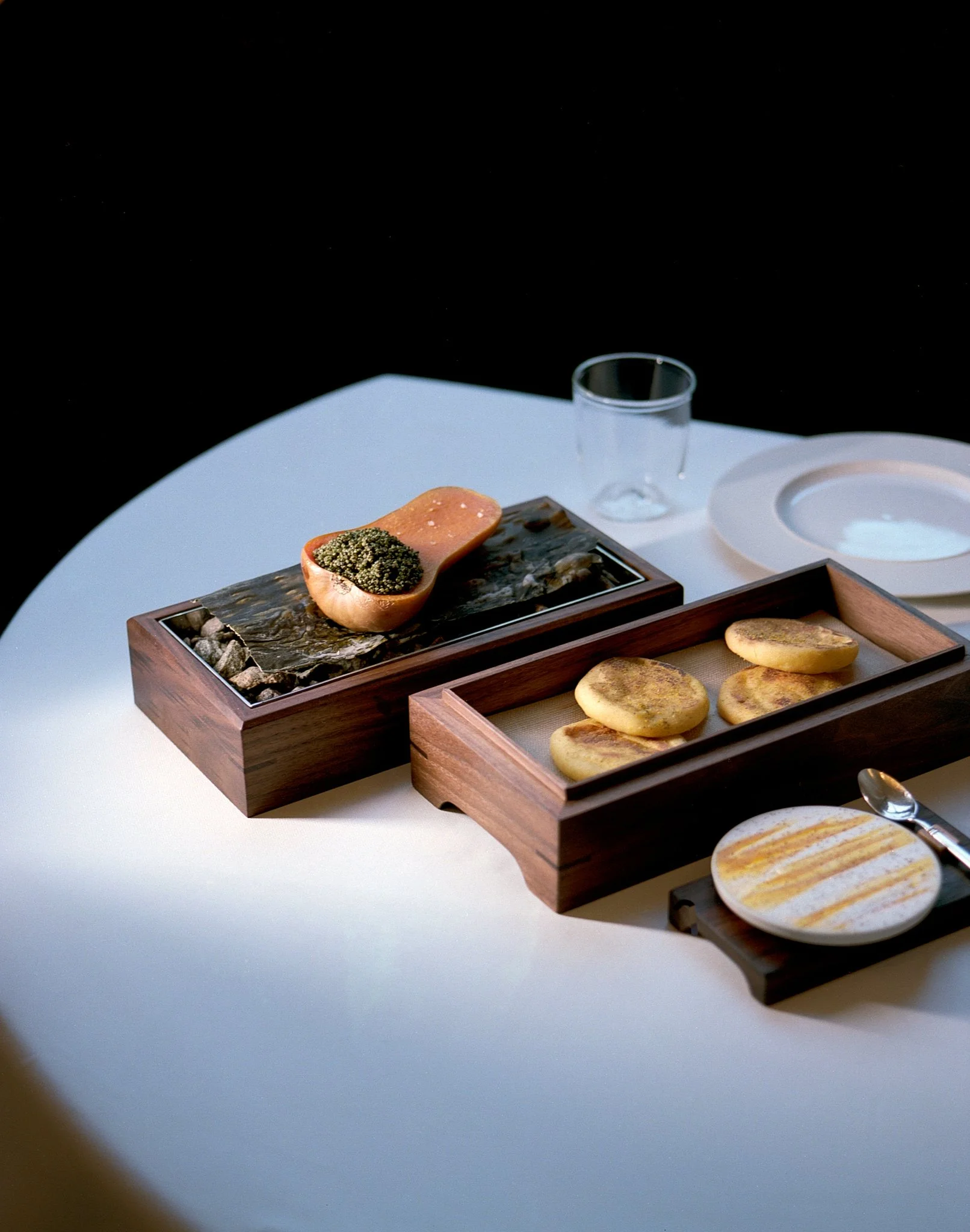
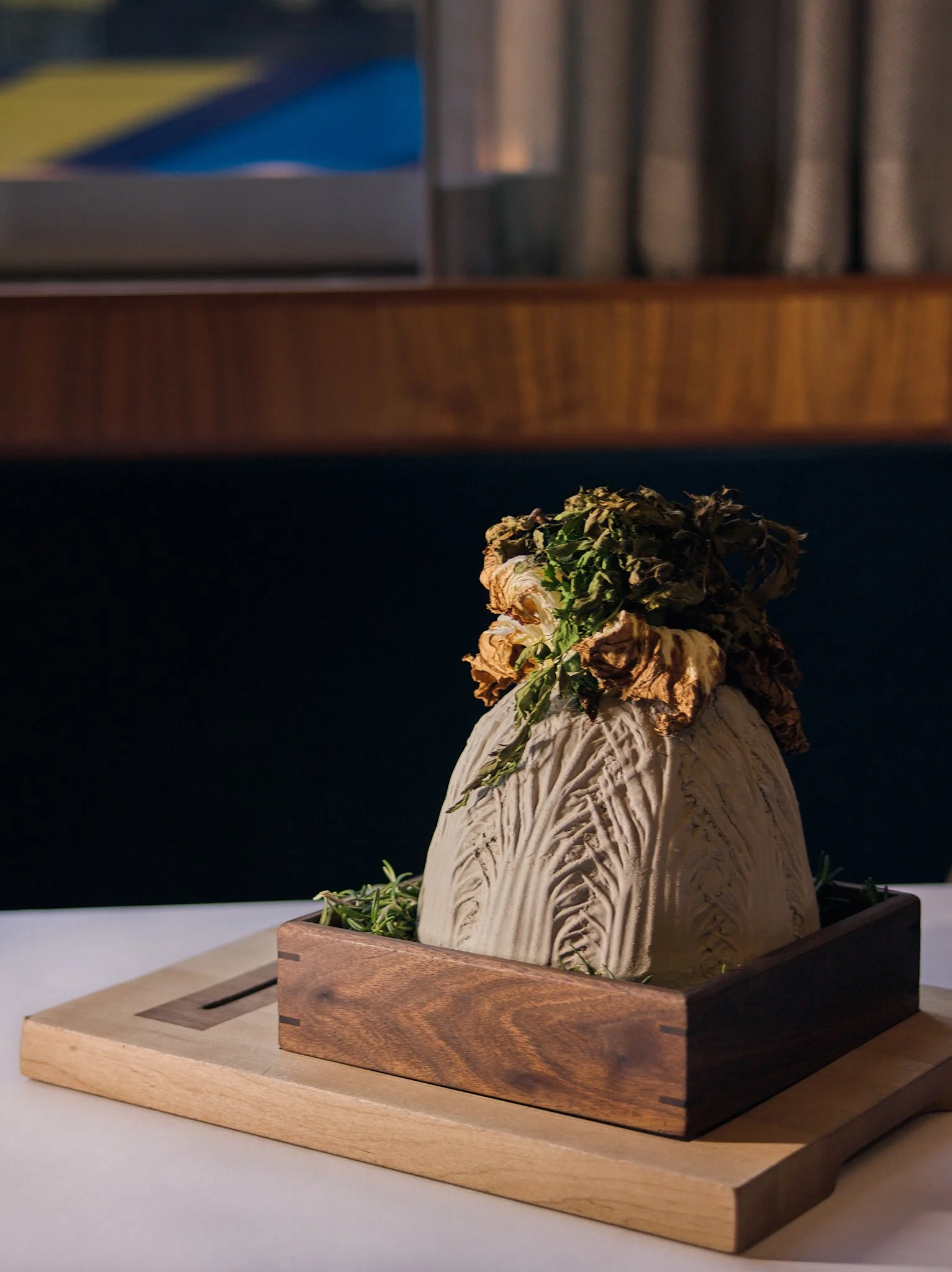
We began with a three-part first course: mushrooms. First: A warm umami-rich broth. Second: A salad with daikon and delicate strands of white enoki — like the kind you’d see floating in a tom yum soup, placed atop darker mushrooms. Third: a tart filled with something reminiscent of a creamy foie gras, topped with lighter-than-parmesan buttery shavings that were also a bit like foie gras, specifically a shaved pile of foie gras I encountered at David Chang’s Momofuku Ko many years ago. The Matsutake, rice porridge with pine and ginger, was big and round and satisfying to chew with edges of bright spice from the ginger. The creamy squash paired with beads of tonburi cut like a ripe, fatty avocado. We slathered it onto small discs of naan with a sumac yogurt-like spread that I understood to be dairy-free, but wasn’t quite sure how. Most scoop the tender sweet meat of the squash out and leave its skin. We also ate the skin. Our server blinked down at the empty box it was served on. “I’ve never seen someone eat the skin.”
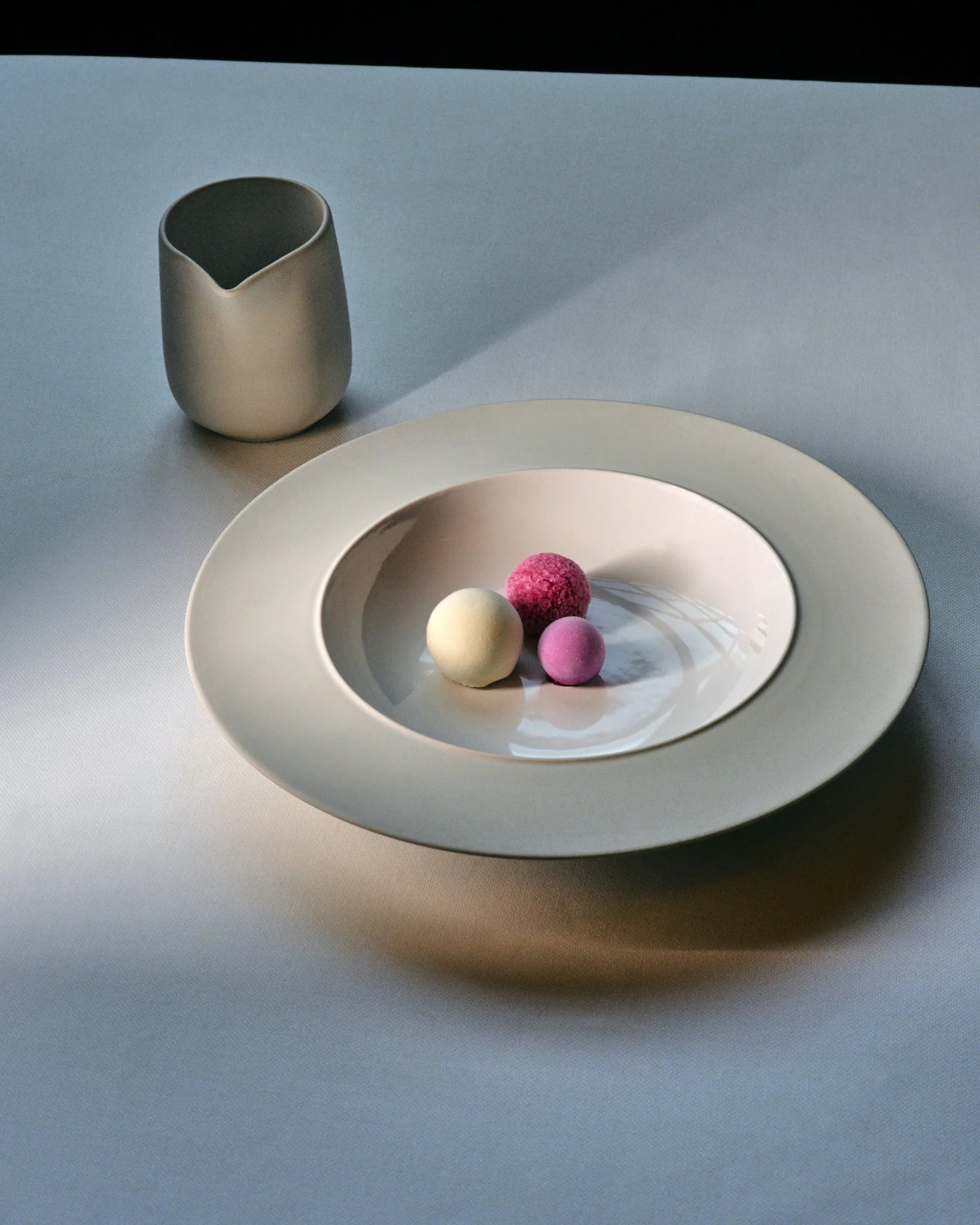
There was a delicate dance going on in the kohlrabi course, with sesame tofu, hazelnut, and truffle — glossy flan-like tofu melted into snaps of kohlrabi, coated in a salty, silky broth-sauce. And while all three sweet courses were memorable, the first, more of a palette cleanser, stood out to me most: two halves of a hockey puck–shaped pear with the insides carved out, served over ice. Within was sarsaparilla, similar in flavor to root beer. The jelly-like tooth-feel, and the carved edges of the pear felt pâte de fruit inspired, those little chewy squares given after a meal. This real fruit version, chilled with a barely-there sweetness, read as an haute back to basics, inspired in its simplicity.
Earlier in the dinner, we were taken back to the enormous kitchen. After surveying the expanse of stainless steel, the choreography of it all, the kitchen-wide “Oui!” that rang out in perfect unison twice (a group confirmation that a new party was seated), I turned to Humm and asked, “Does being in the kitchen still stress you out? Or do you not feel it anymore?”
He followed my eyes and responded very slowly. “Yes. Always. You always are when you care. And I will always care. So much.”