PUBLISHED IN FAMILY STYLE
Scale to Size
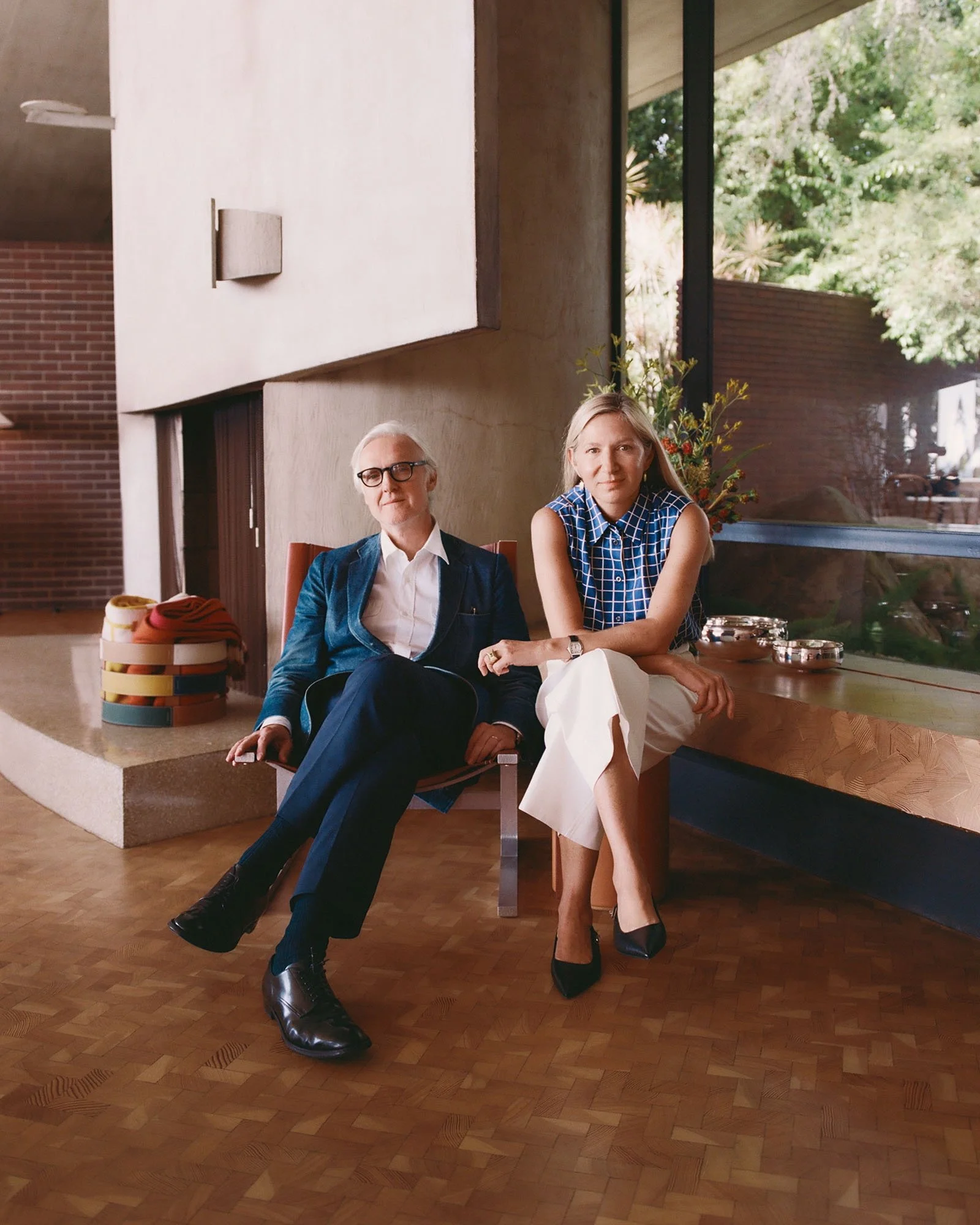
Charlotte Macaux Perelman and Alexis Fabry share more than just the same job. Maison Hermès’ design duo move as two parts of the same brain, whose innovative ideas take shape as enduring forms.
PHOTOGRAPH BY ARIANNA LAGO
CHARLOTTE MACAUX PERELMAN AND ALEXIS FABRY CAME INTO THIS WORLD QUITE SIMILARLY. “We were born in the same hospital,” says Fabry. “And we lived two streets apart all our life,” adds Perelman. The pair’s childhood homes were just west of Paris, along the Seine River in Neuilly-sur-Seine. They fondly recount growing up amid the fullness of interior spaces plump with art and objects—a quintessentially Parisian style that always felt warm and, as Fabry puts it, “not empty.”
As they grew older, their lives diverged onto different creative paths. Perelman, an architect and designer with a small frame and a grounded, elegant intensity, went into hospitality, working for Philippe Starck, David Rockwell, and André Balazs. Fabry, willowy with a soft, professorial air, made his name as a publisher and curator—becoming an expert in Latin American photography and founding Toluca Editions, an art book collection. But in 2014 their unique backgrounds came together when Hermès approached the pair with a special proposition: Helm its home universe, together. They were a curious choice, indeed, with no previous connection to the luxury house and no prior collaborations. But between Perelman’s knowledge of the built world and Fabry’s highly visual affinity for curation, Hermès took a bet on their intuition.
The French house first released a line of leather furniture by renowned French Art Deco designer Jean-Michel Frank in 1928, but it wasn’t until the 2010 opening of a new Paris store on Rue de Sèvres that Hermès Maison established itself as a robust destination for interiors. Under C.E.O. and scion Pierre-Alexis Dumas’ artistic direction, it began to offer not just furniture, but textiles, objects, and wallpaper, as well as the exclusive reissue of Frank’s pieces. And while craftsmanship and that iconic leather have remained a through line, Fabry and Perelman’s stewardship has made the brand more conceptual, with narrative and architecture playing as central a role as the object design itself. Their approach situates items within immersive environments: an interpretation of the stable in 2017; monochromatic tiled “houses” in 2018; and, in 2022, paper-covered wooden frames lit from within to glow like giant lanterns. In practice, their co-leadership has meant everything from laying the philosophical groundwork to overseeing execution.
When they’re not co-directing Maison Hermès, the former childhood neighbors go on vacation together, too, each bringing along their respective families. Their next trip will be to Cairo. “We share the same appetite,” says Perelman. “For ceramics, for vernacular architecture,” continues Fabry. His partner agrees: “And we could talk for hours.” Since joining forces more than a decade ago, their era has been characterized by restraint over spectacle, human touch over industrial gloss, and sustainability through longevity and craftsmanship. Consider their Ancelle d’Hermès armchair, a rectangle of leather draped to become the seat over a minimal wooden frame—its softness turns structural through clever, unadorned utility. Or the imperfect stitchwork of Fabry and Perelman’s Bricole blanket, a reflection of the integral role of the human hand, shining through rather than hidden. While an inarguable French spirit runs through all of their pieces, the duo looks to the entire world for inspiration—from the craftsmanship of Japan to the architecture of Mexico.
This morning, Fabry and Perelman sit side by side on an ivory couch. They’re in Los Angeles’ Silver Lake neighborhood for a special party spotlighting their recent collection: Their pieces fill the iconic mid-century modern Silvertop house, designed by American architect John Lautner. The French brand’s signature Chaine d’Ancre necklace glints from Perelman’s neck, its buttery golden hue complementing her structured, caramel-colored dress. Fabry dons a blue suit, with thick black frames perched on his nose. She is as petite as he is tall, and when one speaks, the other nods, punctuating the gesture with, “Oui.”
The grand living area is dotted with sharp, lean leather chairs in warm brown tones like chestnut and chocolate, the material stretched over frames of pale oak or metal. Sprawling three-seater sofas in breathy ecru, outlined like a sketch by the dark piping around their edges, are anchored on a rug with a crisp, exacting geometric pattern evocative of a Frank Stella painting. Lamps stand along the peripheries, their stems pencil-thin and wrapped in hand-stitched calfskin in shades such as mustard and tomato-red, and auburn and navy. There is a hushed yet playful modularity: side tables with legs that fold up, or whose tops swivel off to reveal storage within, and a credenza with a set of nesting drawers.
Characterized by a sort of biophilic brutalism, the home itself interestingly recalls their favorite shared influence: Luis Barragán. Fabry, who spent two years in Mexico City early in his career promoting French literature at the French Embassy, cites the architect as a transformative influence on him. “There was a before and an after Mexico,” he reflects, “and Barragán was very important.” Similarly, when Perelman was a student at l’École Nationale Supérieure des Beaux-Arts de Paris, the first book she received was about the Mexican architect, a lesser-known name at the time. “I always had this appetite for architects who were a little bit outside of the profession,” she says as she looks around Lautner’s space, sunlight pouring through the skylight above. “It’s like a vernacular, with a relationship between interior life and an exterior, basal tone—how we live as human beings,” she observes. “At Hermès, we are always wondering how people will interact with our objects, so maybe we’re sensitive to materiality.”
The organic nature of a design comes up frequently with these two, the idea of the inanimate as animate, imbued with conscious life force and totemic power. Fabry invokes the Italian architect and designer Andrea Branzi to illustrate this point. “He said some furniture objects are like domestic animals. They have a presence. A chair can be very pleasant to have next to you, even if it’s uncomfortable,” he explains. “Some objects just have a capacity to generate a glow.”
But how to imbue something with a lasting aura? Rigorously high-quality materials and partnering with master craftsmen is a given, but when it comes to a design’s longevity the pair has more interest discussing purity of intention. “Will you still want that object next to you in a few decades?” asks Fabry. “Perhaps, if the intentions are good, the probability is higher,” he continues. “Everybody wants to create objects to give to your children,” adds Perelman. “But will we achieve that? We don’t know. The only thing we can do is try to do it honestly.” They maintain an air of softness here, a mysticism even. It’s wholly unexpected, considering the brand in question: arguably the most precise and polished in the world. “Sometimes we fail,” admits Fabry. “But to fail sincerely is nice,” he says with a smile. Perelman: “Oui”—nod—“oui.”
Fabry likens their partnership to looking in a mirror and seeing a reflection that’s almost yours but not quite: “So you’re always questioning the image.” This counterbalancing of one’s own creative vision is much like the constant weighing of ideas within the creative process at large. “There’s a very strange oscillation in our job, which is staying firm in our beliefs and at the same time being flexible enough to find new ways,” he says.
“Sometimes I wonder if I have to be more strict,” confesses Perelman, considering design leadership. “And sometimes I think, No, I have to be more open-minded... It’s this kind of tension. Where do you start? Where do you stop?” Her counterpart nods sympathetically. “At some point,” Fabry begins, gravely, “that oscillation isn’t there anymore.” Thankfully, they ride through life on a tandem bicycle, to use another one of his metaphors, keeping the wheels turning. “Being together reinforces our conviction,” says Perelman. When it comes down to it, the co-creative directors seldom disagree. Their foundation of trust assures a steady alignment. “They don’t need me,” Perelman wryly states of Hermès. “If I die, it doesn’t matter...” Fabry interjects: “I’m totally the same. If I die, it doesn’t matter. Because we always agree.” They’re somewhere between kidding and being entirely earnest.
They point to their Karumi triangular stool in the corner of the room, designed by Portuguese architect Álvaro Siza. Standing on three legs, the seat looks like stretched fabric fibers from far away. Up close, the running lines reveal themselves to also be bamboo, impossibly pulled and bent like rope. It was a struggle to reproduce Siza’s deceptively simple sketch. The creative directors first attempted to make prototypes in Italy and France, to no avail. They ultimately found their master craftsman in Japan, a country they hold in deep reverence. “They have a relationship with aesthetics, which we’re still learning,” says Perelman. “There’s a big intention in anything that surrounds you,” Fabry describes.
Considering rigor and fantasy, two diametrically opposed spirits crucial to the world of Hermès, Fabry invokes two models from literature: for rigor, Raymond Carver (best known for his minimalist prose and 1981 short-story collection What We Talk About When We Talk About Love); and for fantasy, Gabriel García Márquez (who popularized magical realism with his sweeping novel One Hundred Years of Solitude, 1967). “We now know that Carver’s editor was cutting the ends of his short stories,” he says. “Part of the glow of Carver actually comes from the curating.” Fabry’s passion for books is palpable here; his bespectacled eyes light up as Perelman nods in appreciation, right there with him.
Hierarchy in design is another notable point for the pair—namely, they don’t believe in it. To them, no category of object is more or less noble due to size, costliness, or complexity. If you have a daily relationship with something, no matter how ordinary it is, there is value. “When Philippe Starck designed a toothbrush, he meant to show the toothbrush is as important as your car, because you’re going to use it and look at it every day,” explains Perelman. “I don’t know if I like his toothbrush, but I think it’s interesting. Alessi was amazing for that. The Italian [homeware founder] thought that even a little coffee spoon is important because you would have a relationship with it.”
Ironically, the duo expend the most energy on their smaller-scale designs; a greater care is required when combining several materials into more delicate frames. Take their Apollo 24 Celestial Globes, intricate decorative orbs made for the tabletop. Composed of meticulously printed calfskin, metallic dotted lines, luminous against a deep cobalt, are exquisitely encircled by rings of gold-plated stainless steel—each point of contact on its base is wrapped in tiny leather coverlets for soft contact with a desk. The piece feels like a metaphor: an entire world sized down to the scale of a cantaloupe. “We’re completely comfortable spending months on a small, little thing,” says Perelman. “Scale doesn’t matter. A coffee cup is as important for us as a sofa.” In her own kitchen, her pans are from Jasper Morrison, an iconic English producer known for its elegant simplicity. “I chose them because I see them every day,” she says. “I would never pick just any pan in the supermarket. I wanted them to be amazing.”
When all else fails, their last litmus test for a good design? An object’s relationship to its surroundings. “The harmony is important,” says Perelman. “But sometimes we say harmony is boring,” counters Fabry. “Oui,” Perelman nods, chuckling. “It’s interesting to...” starts Fabry, “Disagree with yourself...” finishes Perelman. “From time to time, to a certain point,” concludes Fabry.
Hermès aside, they have one piece of advice for friends who wish to stay friends while working together: “On vacation, we never talk about work. Never, never. We don’t even share ideas,” says Perelman. “Your husband and my wife would be mad,” adds Fabry. “It’s very pragmatic. Not theoretical. Just pragmatic.” It’s also important to acknowledge one’s own strengths as well as flaws before putting it all to the test. “I have a very bad character,” Perelman professes. “No, no, no!” Fabry interjects. “And he’s very nice,” she presses on, nonplussed. “I’m worse than that,” he humbly counters. “But we still want to go on vacation together. Every Christmas. We’re not fed up with each other,” states Fabry. Both nod: “Oui... oui.”