PUBLISHED IN DOSSIER
Breaking the Mold
Model-turned-designer Armando Cabral reveals the influences and places that inspire his ever-evolving creations.
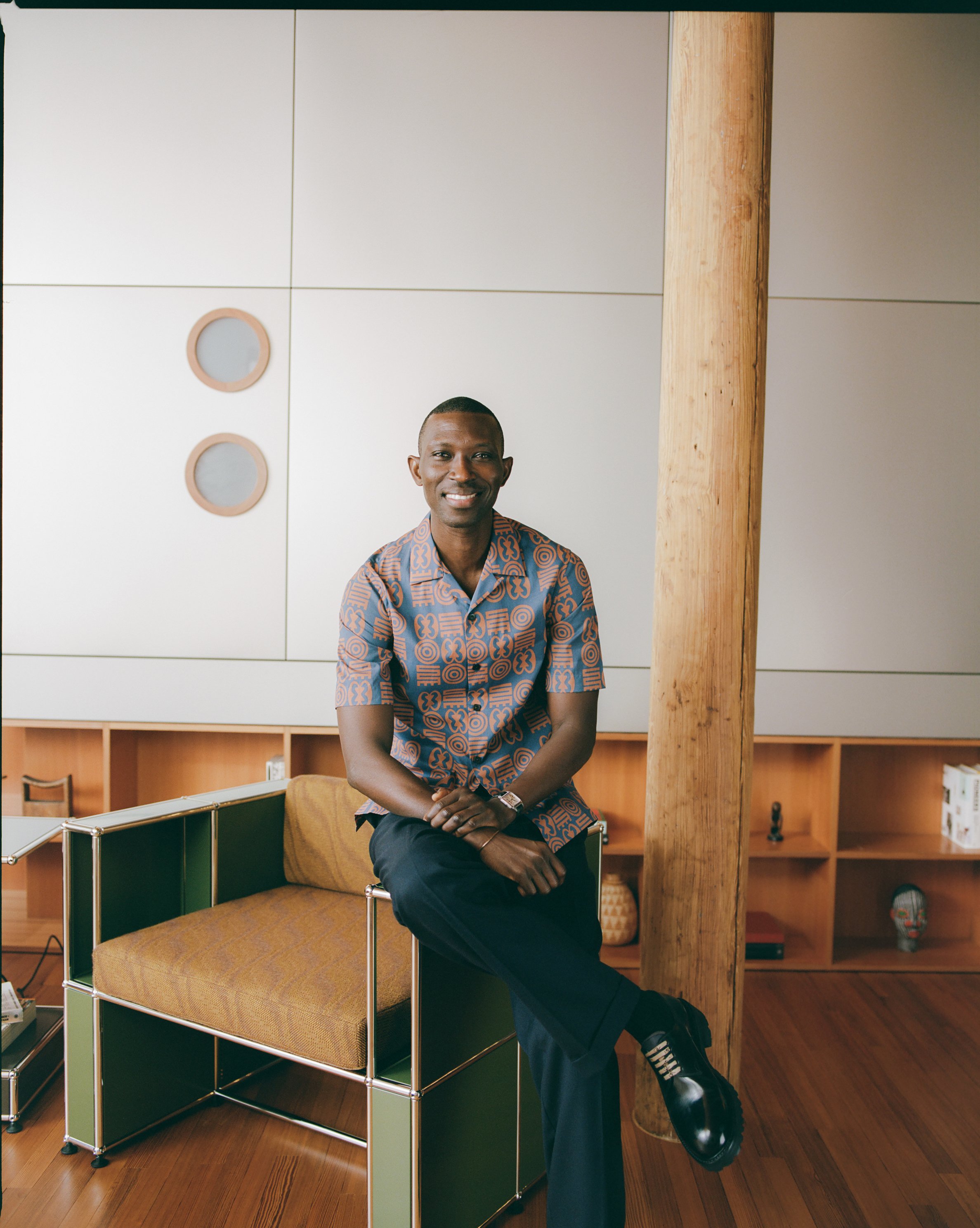
PHOTOGRAPH BY MARCO GALLOWAY
ARMANDO CABRAL’S FIRST ACT in the fashion world was as a model, showing up in campaigns and on runways for brands such as Calvin Klein, Dries Van Noten, Louis Vuitton, Thom Browne, and J. Crew. Today, it’s his work behind the scenes that’s earning him global recognition. Launched in 2008, his eponymous brand is a celebration of African heritage and European craftsmanship brought to life through a broad, meticulous range of fine leather footwear (from supple woven derbies and streamlined sandals to hardy lug boots and ergonomic travel slippers), breezy shirts printed with West African motifs, a home line entitled A Casa, and a custom fragrance. His creations directly reflect his multicultural background: He was born in Guinea-Bissau, raised in Portugal, educated in England, and is now rooted in New York City. Here, Cabral discusses the magic of Lisbon, craft as cultural connector, and the importance of understanding your roots, and he hints at a third act: a foray into hospitality.
Sophie Yun Mancini: What is your perfect day in Lisbon?
Armando Cabral: A perfect day in Lisbon would start at Pastéis de Belém, where they make all the Portuguese tarts. That area is where the presidential palaces are. There’s a monastery next door. It’s just so beautiful. And they have a beautiful park right in front. Then, I would go for lunch at Clube Naval, overlooking the river and the bridge. What I love about these places is they’re still very much for locals. They allow you to take a walk outside the restaurant and sit right by the bay. Later, I would take a stroll downtown where there are a lot of new art galleries. Then, I’d have a drink on one of the rooftops. I love to go to this mini boutique hotel called Memmo Príncipe Real. Their patio that overlooks the city — it’s incredible. The sunset in Lisbon is magical. I think it’s because of the reflection of the sun on the water and over the terra-cotta roofs. I’d probably end with dinner at Sud Lisboa Terrazza. It’s right by the water, with beautiful food, live music. If I felt like I wanted to dance, I would probably go to Lux Frágil, which is one of the biggest clubs in Europe, with all these famous DJs. You could be there until 6 a.m.
SYM: New York, Lisbon — you understand both of these places so well. You have this kind of global citizenship. What are the cultural qualities that you admire about each?
AC: One of the things I love about Lisbon is the sense of family, sense of friendship, sense of home. In Portugal, people stop time. You go to a grocery store, you go to pay, and if you know the locals, it’ll be, “Armando, you’re back! How are you? How’s everything? Oh, I saw this. Oh, have you heard about this? Congratulations!” Mind you, there’s people waiting in the line. And no one minds. People don’t rush in Portugal. Time adapts to them, not the other way around. So everything is kind of slower, a little more melancholic. I always say that, in the U.S., it’s easy to make friends. In Europe, it takes you longer to make friends, but they are your friends forever.
What I have to say about New York is the optimism of Americans. It doesn’t matter how bad things are. It’s like, “We gotta do this,” and then it ends up happening! That optimism brings about the courage to go after whatever it is you really want. Europeans are a little bit more pessimistic, very superstitious. In New York, if you dream it, you can achieve it. But you have to give much of yourself. To achieve the things that I’ve done wouldn’t be possible in Lisbon.
SYM: Optimism is a poetic way of describing the New York spirit, the American spirit. I, in a far more pejorative way, would have said delusion or intensity. But I love your reframing.
AC: I’m telling you! When you talk to people here in Europe, you’re like, “I’m gonna start a company,” and they’re like, “Wait, have you thought this through? Do you have enough money? It’s gonna cost millions for you to do this. I’m not sure. A friend of mine tried this before. Be careful.” And America’s like, “Totally, dude!” They’re like, “I’m in! I’ll add another X amount and be a partner!”
SYM: What are you working on right now?
AC: I have a very interesting project that really bridges Portugal, America, and design in a concept related to hospitality. It should be launching next year. We have a long way to go, but it’s very exciting — the heritage, the craft, and bringing those two worlds [together] in a way that I think will have everybody talking about Portugal. Besides that, the USM collection [a furniture collection Cabral designed in partnership with the Swiss modular furniture brand USM] we did has a second edition that’s launching next year in Portugal, that we’ll bring into the [MAAT, the Museum of Art, Architecture and Technology in Lisbon].
SYM: You started in fashion but have expanded into interiors and are now exploring this hospitality space. How do you think about a shoe versus thinking about a space and the objects within it versus thinking about an experience?
AC: I left Portugal for London to study architecture. I wanted to be an architect; I’ve always loved design. I got to London — vibrant city, beautiful, melting pot of people — and was like, “I don’t have six, seven years to study.” So I switched and went to business school. Then I got into modeling and had the privilege of traveling the world. So design was always inside of me, but it was amplified by traveling, staying in some of the best hotels, going to these beautiful locations. I earned some great money with modeling and thought: Now I need to invest it. So I started [my brand] as a shoe company, but I’ve always viewed it as a lifestyle. There are all these beautiful things I love — experiences and places and things — and the company is my interpretation under one umbrella. I’ve always had a dream to own my own boutique hotel, to bring in the great things some hotels have, and the things they don’t have.
People really care about things that give them some sort of a heritage connection. They’re like, “Oh my God, I watched my grandmother doing this.” There’s something about that that brings us home. We’ve all been to beautiful places, but beautiful places need to reflect something that has some sort of emotional connection. This is where all of these things tie together. Obviously, I don’t work alone. It takes a team to achieve great things, but the vision is really about putting my experiences into place.
SYM: It’s like character development.
AC: Yeah. It is also about valuing things that are not just objects but that add something to you. Same thing with the designs that I did for USM. In the 13th century in Africa, they created all these symbols of life that mean something: gratitude, greatness, dynamism. One of the symbols that was part of the collection is called nkyinkyim. It’s a symbol of community, dynamism, and adaptability. So when you’re looking at that piece, you don’t just say, “What a beautiful bookshelf.” You ask, “What is that?” This creates a conversation, creates connection, and, even in difficult times, it’s a reminder to adapt.
SYM: Are there any additional hidden motifs or hidden backstories in the USM collection that a buyer maybe wouldn’t immediately know, but the secrets are kind of woven into the piece?
AC: The first motif that I used, it’s called nkonsonkonson, which is like a symbol of unity we embroidered in one of the shoes. It was a message reflecting the time when we were coming out of the pandemic. It’s important for us to always unite your health and my health, that one individual plus another individual creates a community.
I remember studying how, back in the day, the weave of African fabrics was also currency. Different patterns had different meanings. They created patterns for newlyweds, wishing them well. For a newborn, there was a pattern to wrap the kids within. So I use all of that stuff as part of our designs.
SYM: That’s definitely an aspect of craftsmanship that we’ve lost in modern times.
AC: I think design and fashion are having a moment of crisis. It’s fast; it’s not much about process. There’s no point in collecting and just accumulating things when they have no meaning. I don’t want to contribute to that.
SYM: How do all of your backgrounds live within you?
AC: Growing up here, I only identified with Portugal. Later on, I came to understand that I cannot be this without that; I cannot be that without this. This is where I started really getting into African history. How beautiful to say this is also part of me? Accepting it added even more value to everything. I think my parents did a great job. Even being in Portugal, we knew our origins. That’s what I’m trying to do with my kids. They’ve been coming to Portugal since they were 3 months old. I travel with them because I know what traveling gave me. We haven’t gone back to Guinea-Bissau yet, but we’re building something there. So once that is done, I want them to start experiencing that to feel like this is part of who you are. Yes, you were born in New York. You’re privileged that you have that. You have a home in New York, you jump on a plane. You have a home in Lisbon, but you also have to look at where you come from.